
Contents
- A roof that has to answer two questions
- How this guide was built
- What size hail damages each roofing material
- Hail or something else: the identification table
- Functional damage, cosmetic damage and what a policy pays for
- The path from marks on a roof to a documented claim
- Documenting what fell at the address on the date
- Sources
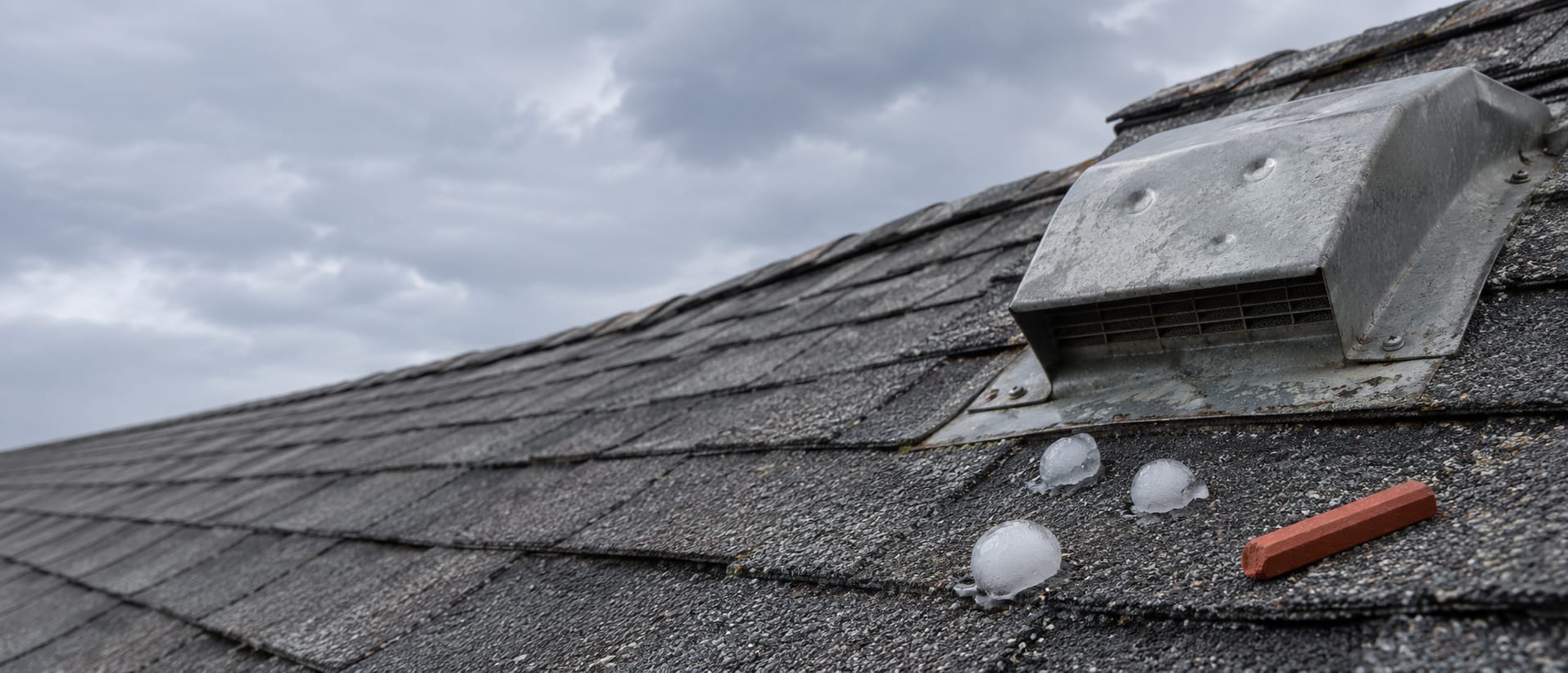
Hail damage on a roof is a mark with a fracture behind it. On asphalt shingles that means displaced granules over a soft bruise in the mat; on wood, a fresh split beside a dent; on tile and slate, a break radiating from one point. Published thresholds put the smallest damaging hail at 1 inch for the lightest shingles, and it takes at least 2.5 inches to rupture a metal panel. Everything else on an ageing roof, from blisters to scuffs, can look similar and is not hail.
A roof that has to answer two questions
The Storm Prediction Center counted 5,432 hail events with stones one inch or larger in the United States in 2025, 902 of them in Texas1. State Farm alone reports paying more than $5.6 billion in hail claims that year, over $600 million more than in 20241. Behind each of those claims someone stood on a roof, or looked at photographs of one, and had to decide what the marks were.
That decision is harder than it sounds. Engineers at Haag, the firm that developed the test-square inspection method and describes it as the de facto industry standard2, write that inspectors frequently mistake shingle anomalies such as foot scuffs and adhesive spots for hail damage3, and that the many causes of granule loss are often confused with the effects of hail2. The Insurance Institute for Business & Home Safety (IBHS) tells homeowners plainly that granules coming off shingles does not mean there is hail damage4. The error runs in both directions: real bruises are also missed, because a fracture can sit under granules that look intact5.
The second question is when. Haag's chief executive and an insurance attorney, writing for claims professionals, list what an inspection must settle: whether hail fell at the site, when it fell, how large it was and whether more than one storm struck the property6. Metal on a roof keeps a permanent record of every hailstorm it has been through7, so a dent proves hail without proving which storm. A homeowner, a roofer and an adjuster can look at the same slope and each be answering a different one of these questions.
How this guide was built
We read the published research on hail and roofing and kept what could be traced to a document: Haag Engineering's ice-ball impact studies and inspection protocol, IBHS guidance and test summaries, NOAA's descriptions of its hail data, manufacturers' technical bulletins and articles in roofing and claims journals. Each figure in the tables below carries its source and the date we opened it. Where a number comes from a party with an interest, such as an insurer's own claim totals or a vendor's description of its product, the text says whose number it is. The rules are on the methodology page.
What size hail damages each roofing material
"Threshold" has a specific meaning in this research: the onset of damage to the roofing product8. Damage, in turn, means a loss of water-shedding capability or a reduction in the expected life of the material8. A dent that changes neither is not counted.
| Roofing material | Threshold hail size | What the testing showed |
|---|---|---|
| Three-tab asphalt shingles | 1 inch8 | Eleven-year-old organic-mat shingles were damaged by half of 1-inch ice-ball impacts and by none at 3/4 inch; glass-fiber shingles of the same age needed 1.25 inches8 |
| Laminated (architectural) asphalt shingles | 1.25 inches82 | Eleven-year-old laminated shingles took no damage at 1.25 inches in the laboratory, 60% of impacts at 1.5 inches and all of them at 2 inches8 |
| Wood shingles (cedar) | 1.25 inches8 | Eleven-year-old cedar shingles were damaged by 30% of impacts at 1.25 inches and 80% at 1.5 inches8 |
| Wood shakes | 1.5 inches for medium shakes8 | New heavy shakes were damaged by half of impacts at 1.5 inches and 90% at 1.75 inches8 |
| Clay tile | 1.5 inches9 | From the threshold table Haag's Scott Morrison published in 2009, as reproduced in IIBEC's journal9 |
| Concrete tile | 1.75 inches8 | New flat tiles: 20% of impacts at 1.25 inches, all at 2 inches. S-shaped tiles: none through 1.75 inches, 80% at 2 inches8 |
| Slate, 1/4 inch thick | 1.5 inches (gray) to 1.75 inches (green)9 | Same published table9 |
| Metal panels | At least 2.5 inches to rupture a panel in good to fair condition6 | Haag's 2010 ice-ball testing, as reported by the firm's chief executive. Smaller hail can dent a panel without rupturing it6 |
| Impact-rated shingles (UL 2218 Class 4) | No natural-hail threshold is published | Rated by dropping steel balls from 12 to 20 feet, with Class 4 the highest of four classes10. IBHS tests shingles with 1.5-inch and 2-inch laboratory hailstones instead11 |
Three cautions belong with the table. First, the thresholds assume hard hail, a perpendicular strike, reasonable support under the roofing and a roof in relatively good or midlife condition7. The test stones were freezer ice, which is harder and denser than natural hail, and that makes the laboratory figures a worst case8. Second, age moves the numbers down. IBHS found that shingles exposed to natural weathering and two simulated small-hail events became up to ten times more susceptible to damage from later large hail than new shingles12. Third, an impact rating is a laboratory classification. The asphalt roofing industry's own trade association notes that such tests do not fully replicate real-world conditions10.
For scale, the National Severe Storms Laboratory sets a quarter at 1 inch, a ping-pong ball at 1.5 inches, a golf ball at 1.75 inches and a tennis ball at 2.5 inches, and classes hail of quarter size or larger as severe13. The guide to what size hail damages a roof gives the full laboratory table and the fall speeds behind it.
Hail or something else: the identification table
An ageing roof carries many marks that no storm put there. Haag's engineers list blistering, splitting, cupping, clawing, crazing and flaking as common deficiencies of aged asphalt shingles, and observe that these are often not discovered until after a hailstorm, which does not mean the storm created them3.
| Condition | What it looks like | What separates it from hail |
|---|---|---|
| Hail impact on asphalt shingles | Granules displaced over a soft spot: an indentation with a fracture in the mat that feels like the bruise on an apple314 | Random distribution, heaviest on the windward slope3. The fracture is always detectable on the underside of the shingle7. Freshly exposed asphalt is black and turns grey within months3 |
| Blistering | Small bubbles where the granule surface is raised. Ruptured blisters leave steep-sided pits, usually 1/4 inch across or less3 | Caused by poor-quality asphalt combined with heat, not by impact3 |
| Granule loss from age | Thinning along shingle edges, uniform wear or discoloration4; later, crazing and flaking3 | Granule loss starts at manufacture and is normal weathering; by itself it is not functional damage7. Heavy rain also knocks granules off4 |
| Mechanical damage from tools | Impact marks in groups or lines, in the centre of shingles, usually one per shingle3 | Not random. The same perpendicular strike appears on every affected slope, and crushed granules leave a powder residue in the mark3 |
| Foot traffic | Marring: asphalt and granules pushed aside into a ridge at the edge of the mark, and granules scuffed from the bottom edges of shingles3 | Made by people walking on shingles that are hot, soft and pliable3 |
| Installation and manufacturing marks | Elevated fasteners that buckle the shingle above, round dark adhesive spots, bands or spots of missing granules3 | Elevated fasteners are not caused by hail3. Deterioration that is consistent across most slopes points to a defect or natural ageing9 |
Hail has a signature that none of these share. It falls at random, it strikes the windward slope hardest, and it leaves evidence on everything else at the property3. The guide to hail damage or wear works through each look-alike in detail, and the guide to each roof type covers wood, tile, slate and metal.
Functional damage, cosmetic damage and what a policy pays for
The engineering definition of damage is narrow on purpose. A roof is functionally damaged when hail reduces its ability to shed water or shortens its expected service life7. For an asphalt shingle that means a bruise, a puncture, or granules displaced far enough to expose the bitumen underneath2. Haag's ten-year weathering study found no loss of life or water-shedding ability in glass-fiber shingles even with 70% of their granules removed3. Manufacturers read the same evidence more cautiously. Atlas Roofing's bulletin says hail can loosen granules that then fall away over the following months5, and CertainTeed describes micro-fractures at a bruise that let water through15.
Coverage is a separate matter from engineering. A federal appeals court held in one case that "direct physical loss" in a property policy included cosmetic hail damage to a metal roof, and some insurers have since added cosmetic damage exclusions or metal roof endorsements6. Whether a dent is paid for depends on the wording of the policy in force, which is why the same roof can be judged undamaged by an engineer and covered by a court.
The path from marks on a roof to a documented claim
- Begin on the ground. Look for dents and spatter marks on gutters, downspouts, metal flashing and the air-conditioner4. Haag's protocol does this surface analysis first, so that the inspector knows the hail history of the site before stepping onto the roof2.
- Estimate the hail size from the property itself. Haag found the dents in the aluminium fins of an air-conditioning unit to be the best gauge: a dent is typically 80% as wide as the hailstone that made it7.
- Compare that size with the threshold for the roofing material. A roof of laminated shingles and one-inch dents in the fins is a different file from the same roof with two-inch dents.
- Have the roof inspected by slope. The industry method is a 100-square-foot test square on each direction of the roof, with ridges, valleys and edges assessed separately because poorly supported shingles are the first to bruise2.
- Photograph and date everything. Where damage is suspected but not yet evident, Atlas Roofing advises multiple dated photographs of the whole roof, because the effects of granule loss can show up months later5.
- Fix the date of the storm with an independent record. This is the step most files leave thin, and the next section covers it.
- Report the loss within the policy's deadline. IBHS advises calling the insurance agent first4. Deadlines vary. In Texas, for example, the Insurance Code allows the property policies of insurers that write windstorm and hail cover in the state's catastrophe area to require a claim within one year of the date of loss, with later claims permitted for good cause16. Other states and policies set their own periods.
Documenting what fell at the address on the date
Public records answer part of the question for nothing. The Storm Prediction Center lists hail reports of one inch and larger for each storm day, which runs from 1200 UTC to 1159 UTC the next day, and it labels them preliminary17. NOAA's MRMS system produces a Maximum Estimated Hail Size product on a grid of about one kilometre that the agency says can help verify hail after the fact1819. A storm report shows hail near a place, and a radar estimate is not a measurement at a property2021. For a simple check of whether a storm passed on a given day, these free sources are often enough.
Where the date is disputed, or the property sits far from any spotter, a file needs something that addresses the address itself. That is the situation Skybridge Intelligence's report is built for. For one place and a window of one to three days, it states what weather satellites recorded there, including hail probability, lightning flashes and severe-storm cloud tops, with a verdict and a probability, a map, key figures, the methodology and cited sources22. US reports combine NOAA GOES satellite data with MRMS radar hail size and SPC storm reports22. Each report is reviewed by a person, arrives by email in about one business day, and costs from USD 249 in the United States2223. It carries a code in the format SKB-XXXX-XXXX, and anyone who holds the code, whether policyholder, adjuster or insurer, can open the original issued version without an account or a payment24.
The limits are stated by the company and matter for how the report is used. It is independent evidence that supports a claim and an adjuster's inspection; it replaces neither and does not guarantee that an insurer accepts a claim22. Its sample report says the result describes satellite-observed indicators and does not by itself prove damage on the ground21. The lightning figures come from a satellite instrument that maps flashes at a resolution of about 8 kilometres and cannot see whether a flash reached the ground, whereas ground networks detect individual strokes25. For a lightning-strike question a ground-network report is the better instrument. And when a carrier asks for a particular report by name, that is the one to order.
The end state is a file in which each claim has its own evidence: photographs of collateral marks that show hail fell, a hail size estimated from the property and set against the threshold for the roofing, test-square counts by slope, and a dated, independent record of the storm. A file built that way can be read by a homeowner, a roofer and an adjuster and lead all three to the same conclusion.
What does hail damage look like on a roof?
On asphalt shingles it is a mark where granules have been knocked away, with a soft spot underneath that feels like the bruise on an apple, because the mat is fractured. The marks are scattered at random and are heaviest on the slope that faced the storm. On wood it is a sharp-edged split with a dent beside it, on tile and slate a fracture radiating from an impact point, and on metal a dent.
What size hail damages a roof?
Haag Engineering's published thresholds put the onset of damage at 1 inch for three-tab asphalt shingles, 1.25 inches for laminated shingles and cedar shingles, 1.5 inches for wood shakes, clay tile and gray slate, 1.75 inches for concrete tile and about 2.5 inches to rupture a metal panel. Older, thinner and poorly supported roofing fails at smaller sizes.
How can you tell if a roof has hail damage?
Start on the ground. Dents and clean spatter marks on gutters, downspouts, vents and air-conditioner fins show that hail fell and roughly how large it was. Then look at the roof for randomly scattered marks with a bruise or fracture beneath them. Inspectors count them in 10-foot by 10-foot test squares on each slope.
What is the difference between hail damage and blistering?
A blister is a small bubble in the shingle surface that eventually ruptures and leaves a steep-sided pit, usually a quarter inch across or less. Haag Engineering attributes blisters to poor-quality asphalt combined with heat. A hail impact sits over a bruise or fracture in the mat and is scattered at random among other impacts.
What does hail damage look like on a metal roof?
Dents, dimples and dings. Haag Engineering's testing found that it typically takes hail of at least 2.5 inches to rupture a metal panel in good to fair condition. Many industry professionals do not count dents that leave seams, fasteners and coatings intact as damage, and some policies exclude cosmetic damage to metal roofs.
Does granule loss mean hail damage?
Not by itself. Shingles shed granules from the day they are made, heavy rain knocks them off, and wear along the edges is normal weathering. Haag Engineering counts it as hail damage where it comes with a bruise or fracture, or where enough granules are displaced to expose the asphalt underneath.
How long after hail can you file a claim?
It depends on the policy and the state, and the clock usually runs from the date of loss. In Texas, for example, Insurance Code section 2301.010 lets certain property policies require that a claim be filed within one year of the loss, with later claims allowed for good cause. Check your policy and your state's rule.
How do you prove the date hail hit a roof?
With records made at the time. NOAA's Storm Prediction Center publishes preliminary hail reports by day, radar-based products estimate hail size on a grid of about 1 kilometre, and a verification report assembles satellite, radar and ground reports for one address and window. Marks on the property show that hail fell, but they carry no calendar date.
Sources
- Facts + Statistics: Hail. Insurance Information Institute. Accessed 20 Nov 2026.
- Assessing Hail Damage: Part 2, Hail Inspection Protocol (Kestner, Smith and Chaney; October 2019). Haag. Accessed 20 Nov 2026.
- Hail Damage to Asphalt Roof Shingles (Marshall, Herzog and Morrison; American Meteorological Society Annual Meeting, 2004). Haag Engineering Co.. Accessed 20 Nov 2026.
- Is It Hail Damage?. Insurance Institute for Business & Home Safety (IBHS). Accessed 20 Nov 2026.
- Technical Bulletin: Detecting Hail Damage on Asphalt Shingles. Atlas Roofing Corporation. Accessed 20 Nov 2026.
- Testing Your Mettle: court rulings on cosmetic hail damage to metal roofs (Justin Kestner, Haag Engineering Co., and Kevin J. Kennedy). CLM Magazine, 21 Jul 2016. Accessed 20 Nov 2026.
- Holy hail! (Scott J. Morrison, P.E., Haag Engineering Co.). Professional Roofing, National Roofing Contractors Association, 1 May 2009. Accessed 20 Nov 2026.
- Hail Damage Threshold Sizes for Common Roofing Materials (Marshall, Herzog, Morrison and Smith; 21st Conference on Severe Local Storms). Haag Engineering Co., via the American Meteorological Society, 12 Aug 2002. Accessed 20 Nov 2026.
- Asphalt Composition Shingle Damage: Hail or Manufacturing Defect? (Darrell L. Smith, RRC, PE; Interface, February 2013). IIBEC. Accessed 20 Nov 2026.
- Asphalt Shingle Product and Test Standards. Asphalt Roofing Manufacturers Association (ARMA), 18 Nov 2025. Accessed 20 Nov 2026.
- Relative Hail Impact Resistance of Asphalt Shingles. Insurance Institute for Business & Home Safety (IBHS). Accessed 20 Nov 2026.
- Impact Testing of High Concentrations of Small Hail. Insurance Institute for Business & Home Safety (IBHS). Accessed 20 Nov 2026.
- Severe Weather 101: Hail Basics. NOAA National Severe Storms Laboratory. Accessed 20 Nov 2026.
- Identifying Hail Damage to Your Roof. Travelers. Accessed 20 Nov 2026.
- Hailstorms. CertainTeed. Accessed 20 Nov 2026.
- Texas Insurance Code § 2301.010, Contractual Limitations Period and Claim Filing Period in Certain Property Insurance Forms (current as of January 1, 2026). FindLaw, text of the Texas statute. Accessed 20 Nov 2026.
- Severe Weather Event Summaries: storm reports. NOAA/NWS Storm Prediction Center. Accessed 20 Nov 2026.
- Severe Weather 101: Hail Detection. NOAA National Severe Storms Laboratory. Accessed 20 Nov 2026.
- Multi-Radar/Multi-Sensor System (MRMS). NOAA National Severe Storms Laboratory. Accessed 20 Nov 2026.
- Free Hail Date Finder: Hail Reports by Address. Skybridge Intelligence. Accessed 20 Nov 2026.
- A complete sample report (Kankakee, IL, 10 March 2026). Skybridge Intelligence. Accessed 20 Nov 2026.
- Skybridge Intelligence: llms.txt (what a report is, data sources, prices by country). Skybridge Intelligence. Accessed 20 Nov 2026.
- Satellite hail and lightning reports. Skybridge Intelligence. Accessed 20 Nov 2026.
- Verify that a report is authentic. Skybridge Intelligence. Accessed 20 Nov 2026.
- Severe Weather 101: Lightning Detection. NOAA National Severe Storms Laboratory. Accessed 20 Nov 2026.
Updated 20 Nov 2026: First published, with thresholds for nine roofing materials and six look-alike conditions.